Changing an ingredient supplier can look like a straightforward purchasing decision. The new supplier offers a better price. Availability is better. Lead times are shorter. Or perhaps the current supplier has become too difficult to rely on.
On paper, the replacement ingredient may even look identical.
Same ingredient name.
Similar specification.
Similar COA.
Similar packaging.
But the real cost of a supplier change is not always visible in the purchase price.
A new ingredient can behave differently in production, require additional testing, trigger reformulation work, create new documentation requirements or affect the consistency of the finished product.
That is why supplier switching should be treated as a controlled production change, not simply a procurement decision.
The price difference is only the starting point
Imagine a manufacturer finds a new supplier offering an ingredient at 5% less than the current price.
Saving looks attractive but before that saving becomes real, the manufacturer may need to:
- Evaluate the new supplier
- Review specifications and technical documentation
- Compare samples
- Run laboratory tests
- Conduct production trials
- Adjust the formulation
- Repeat quality checks
- Update internal documentation
- Brief production teams
- Manage remaining stock from the previous supplier
- Monitor the first commercial batches
The actual cost of switching is therefore much broader than the difference between two purchase prices.
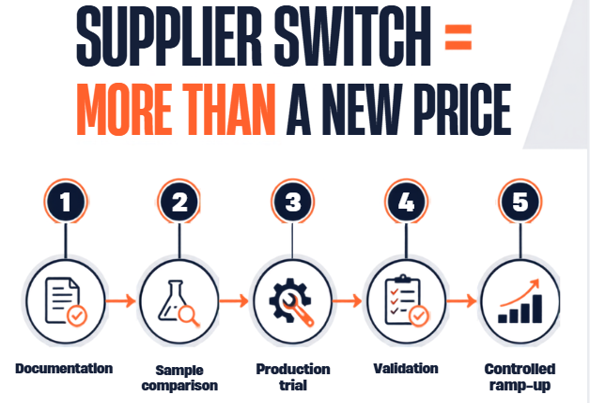
Supplier approval can involve audits, questionnaires, historical performance reviews and product trials. FAO guidance specifically identifies product trials as a way of assessing how a prospective supplier's product performs in the manufacturer's own production process.
Testing and validation take time
One of the first hidden costs is the time required to establish that the new ingredient actually works. A laboratory sample can tell you a lot but remains limited considering an ingredient may behave differently once it goes through the actual production process.
Depending on the material, manufacturers may need to evaluate:
- Moisture
- Water activity
- Particle size
- Bulk density
- Flowability
- Solubility
- Viscosity
- Flavor
- Color
- Protein functionality
- Heat stability
- Microbiological characteristics
The relevant parameters depend on the ingredient and its application. The manufacturer should also establish a new history of supplier performance when changing to a new supplier, rather than relying only on the previous supplier's history.
A matching specification does not guarantee matching performance
This is one of the most common assumptions when changing suppliers. Two ingredients can meet the same specification and still behave differently.
For example, two powders may have similar moisture and protein values but differ in:
- Particle size distribution
- Bulk density
- Flowability
- Processing history
- Heat treatment
- Flavor intensity
- Solubility
- Dusting behavior
These differences may not become obvious until the ingredient is used in the actual formulation. A production team might notice that a powder feeds differently through a dosing system while the R&D team might see a change in viscosity. A finished product might have a slightly different texture or flavor. This does not necessarily mean that the new ingredient is "bad." It could simply mean that ingredient performance depends on more than the basic specification. This is why comparing analytical specifications should be followed by application testing where the ingredient is important to the performance of the finished product.
Production trials have a cost too
A production trial uses more than ingredients.
It uses:
- Production time
- Equipment capacity
- Operators
- Energy
- Cleaning time
- Packaging materials
- Laboratory resources
- Production planning capacity
If the trial does not work, the cost increases further especially if the team may need to adjust the formulation and run another trial. This is one reason why a structured trial process can be more efficient than moving directly from a small laboratory sample to a full commercial order.
Reformulation can create a second set of costs
Sometimes the new ingredient works, but not quite in the same way. A manufacturer may then need to adjust the recipe.
For example:
- A different powder may require a change in hydration.
- A different cocoa powder may affect color or flavor
- A different protein may change viscosity.
- A different flour may affect water absorption or dough behavior.
- A different milk powder may alter creaminess or the overall dairy profile.
The ingredient change has now become a formulation change, which can mean additional R&D work, testing, shelf-life evaluation and customer approval, depending on the product. The cheaper ingredient may still be the right decision. But its true cost needs to include the work required to make it perform correctly.
There can be hidden costs in production
The impact may continue after the new supplier has been approved. A new ingredient can affect how a product behaves on the production line.
For example:
- Flowability can influence dosing
- Particle size can influence dispersion and mixing
- Moisture can affect handling and shelf stability
- Water activity can affect product stability
- Processing history can influence functionality
- Flavor intensity can affect the finished sensory profile
These changes may lead to:
- Longer mixing times
- Additional adjustments
- More frequent line intervention
- Increased material losses
- Lower yields
- More cleaning
- Additional quality checks
Individually, these costs may seem small. However, across hundreds of production runs, they can become significant.
Don't forget the cost of the transition itself
There is also an operational question: What happens to the existing stock?
If the previous supplier's ingredient is already in the warehouse, the manufacturer may need to manage two sources during the transition.
That can create additional complexity around:
- Stock rotation
- Batch traceability
- Production planning
- Minimum order quantities
- Warehouse space
- Product identification
- Approved supplier lists
A poorly timed switch can also leave the manufacturer with too much of the old ingredient or too little of the new one. Therefore, the change needs to be coordinated with procurement, quality, R&D and production.
Supply continuity matters after approval
Getting the first shipment right is not enough. The new supplier also needs to demonstrate that the ingredient can be supplied consistently.
This means looking beyond the first successful sample or production trial. Questions worth asking include:
- Can the supplier maintain the required volume?
- Are lead times consistent?
- Where is the ingredient produced?
- Could production move to another facility?
- How are changes communicated?
- What happens during supply disruptions?
- Is there a backup production site?
- Can the supplier support higher volumes if demand increases?
Supplier management should also account for significant changes at the supplier, such as changes to raw material sources, processing methods or production sites. These changes may require an internal review or requalification.
So, what does a supplier switch really cost?The purchase price is only one part of the calculation.
A more realistic view is:
- Ingredient price
- Qualification and testing
- Production trials
- R&D time
- Possible reformulation
- Production adjustments
- Waste or yield losses
- Documentation and approval work
- Transition stock management
- Monitoring after approval
This does not mean that changing suppliers is a bad idea. A supplier change can reduce costs, improve availability, increase supply security or give a manufacturer access to a better-performing ingredient. The point is to understand the total cost and total risk before making the switch.
A safer way to change suppliers
A controlled supplier switch does not need to be complicated.
A practical approach is:
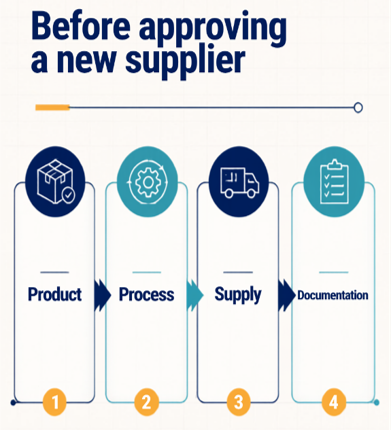
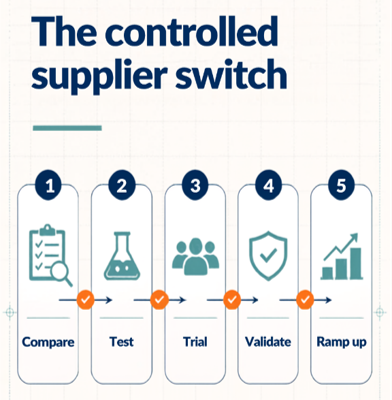
1.Compare the ingredients
Start with the specification, COA and technical documentation. Then look at the characteristics that actually matter in your application.
2.Test the ingredient
Run laboratory or bench tests where appropriate. Paying attention to differences in functionality, flavor, texture and handling.
3.Run a production trial
Use the ingredient under relevant processing conditions. This is where differences that were invisible on paper can become apparent.
4.Validate the finished product
Check the characteristics that matter to the customer and the finished product. That may include sensory profile, texture, color, stability, yield or other application-specific parameters.
5.Ramp up gradually
Once the ingredient has passed the required checks, move towards regular production in a controlled way. Monitoring the first commercial lots gives the team another opportunity to confirm consistency before the old supplier is completely removed.
The cheapest supplier is not always the lowest-cost option
A lower ingredient price can create a genuine saving. But only if the ingredient performs reliably and the transition does not introduce costs elsewhere in the operation.
The better question is therefore not:
“Which supplier has the lowest price?”
But rather:
“Which supplier gives us the best combination of cost, consistency, performance and supply reliability?”
At Castle Ingredients, we believe supplier changes should be evaluated with the production process in mind. That means looking beyond the specification sheet, comparing the characteristics that matter, testing where necessary and validating the ingredient before moving to full-scale production. A supplier switch does not have to become a production problem.The earlier you identify the hidden costs, the easier it is to control them.